


Lock-in Amplifier Working Principle: Extract Weak Signals via PSD |
A lock-in amplifier is a specialized device for weak signal detection. Based on the coherent detection method, it extracts and accurately measures target signals buried in various noise. Its core technology is phase-sensitive detection: it uses a reference signal with the same frequency and fixed phase relationship as the test signal as the benchmark, filters out noise of mismatched frequencies, and isolates useful signal components.
Limitations of Traditional Weak Signal Processing |
Amplification is the most basic treatment for weak signals. However, traditional amplification boosts both the target signal and noise simultaneously. Without bandwidth limiting or filtering, any amplification will reduce the signal-to-noise ratio (SNR). Therefore, filtering must be applied first to purify the signal and improve SNR for accurate measurement.
Taking a 10 nV, 10 kHz sine wave signal as an example, paired with a high-quality low-noise amplifier with 5 nV/√Hz input noise:
- Wideband amplification: With 100 kHz bandwidth and 1000× gain, the output signal reaches 10 μV, but the wideband noise hits 1.6 mV. The signal is completely covered by noise and cannot be measured.
- Band-pass filtering: With an ideal band-pass filter (Q=100, center frequency at 10 kHz), the passband width is narrowed to 100 Hz. The output signal remains 10 μV, while the passband noise drops to 50 μV. Noise is still far larger than the signal, making valid measurement impossible.
- Phase-sensitive detection: Equipped with a phase-sensitive detector (PSD), the equivalent detection bandwidth can be as narrow as 0.01 Hz at 10 kHz. The output signal stays at 10 μV, while the noise is reduced to only 0.5 μV. The SNR reaches 20, supporting accurate signal measurement.
Phase-Sensitive Detector (PSD) Principle |
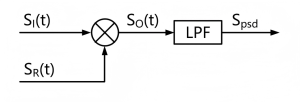
A phase-sensitive detector is equivalent to an extremely narrow band-pass filter. It consists of a multiplier module that multiplies the input signal by the reference signal, and a low-pass filter module for the multiplication result. In some technical definitions, PSD refers only to the multiplier unit without the filter.
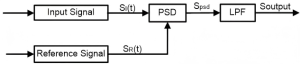
Single-Phase Lock-in Amplifier Structure |
The noise-contaminated signal enters the signal channel, and the reference signal with a fixed frequency relation enters the reference channel. The two channels are fed into the PSD together, forming a complete single-phase lock-in amplifier architecture.
Mathematical Derivation |
Signal channel input to PSD:
SI(t)=AIsin(ωt+φ)+B(t)
Where AIsin(ωt+φ) is the target signal, ω is the angular frequency, and B(t) is total noise.
Standard reference signal:
SR0(t)=ARsin(ω0t+θ)
After multiplication in PSD:
SPSD0=0.5AIARcos[(ω−ω0)t+φ−θ]−0.5AIARcos[(ω+ω0)t+φ+θ]+B(t)ARsin(ω0t+θ)
When the reference frequency matches the test signal frequency (ω0=ω):
SPSD=0.5AIARcos(φ−θ)−0.5AIARcos(2ωt+φ+θ)+B(t)ARsin(ωt+θ)
After low-pass filtering, high-frequency components and most noise are removed, leaving a DC output related to signal amplitude and phase difference.
Conclusion |
Lock-in amplifiers realize ultra-narrow band filtering through phase-sensitive detection, greatly suppress in-band noise, and significantly improve SNR. It is a reliable solution for accurate measurement of weak signals submerged in noise.
Related products: |
Lock-In Amplifiers: Principle, Applications & Products | Saluki Technology
♦ Need technical support or a custom solution? Contact our application engineers: saluki@salukitec.com.
♦ To request a quotation, please contact sales@salukitec.com or click “Contact Us“ to leave a message.
