


Lock-in Amplifier Applications and Working Principles in Typical Scenarios |
Lock-in amplifiers have a broad range of applications, including temperature detection, photoelectric detection, biosignal detection, and geological exploration. Below is a detailed introduction to two typical application scenarios.
1. Solar Cell Quantum Efficiency Measurement |
1.1 Two Types of Quantum Efficiency |
Solar cell quantum efficiency is divided into external quantum efficiency and internal quantum efficiency:
- External Quantum Efficiency (EQE): The ratio of the number of charge carriers generated in a solar cell to the number of incident photons of a given energy reaching the cell surface.
- Internal Quantum Efficiency (IQE): The ratio of the number of charge carriers generated in a solar cell to the number of photons of a given energy that are not reflected and not transmitted through the cell surface.
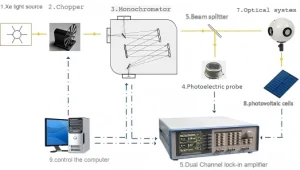
1.2 Test System and Working Principle |
A solar cell quantum efficiency measurement system consists of a dual-channel lock-in amplifier, optical chopper, monochromator and other core devices. The probe light emitted from the monochromator is split into two beams: one beam is converted into photocurrent and fed into the lock-in amplifier as a reference; the other beam irradiates the solar cell, and the resulting photocurrent is measured by the second channel of the lock-in amplifier.
The ratio of the two channel measurements, combined with relevant formulas, is used to calculate the quantum efficiency of the solar cell.
2.Scanning Tunneling Spectroscopy Application |
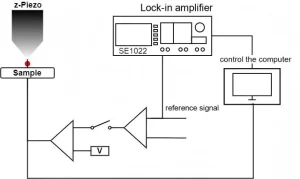
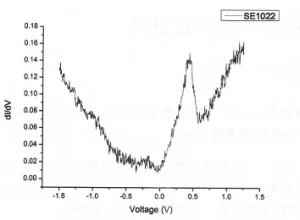
Scanning Tunneling Spectroscopy (STS) performs I-V or dI/dV-V measurements at a fixed position on the sample surface to obtain scanning tunneling spectra with characteristic peaks. At the voltage corresponding to the characteristic peak, with the average current kept constant, the tip scans across the X-Y plane to measure the variation of dI/dV with X and Y coordinates, producing a scanning tunneling spectroscopy image. The electronic and chemical properties of the sample surface can be characterized via I-V curves and dI/dV-V spectra.
Related products: |
Lock-In Amplifiers: Principle, Applications & Products | Saluki Technology
♦ Need technical support or a custom solution? Contact our application engineers: saluki@salukitec.com.
♦ To request a quotation, please contact sales@salukitec.com or click “Contact Us“ to leave a message.
