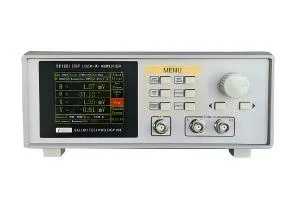

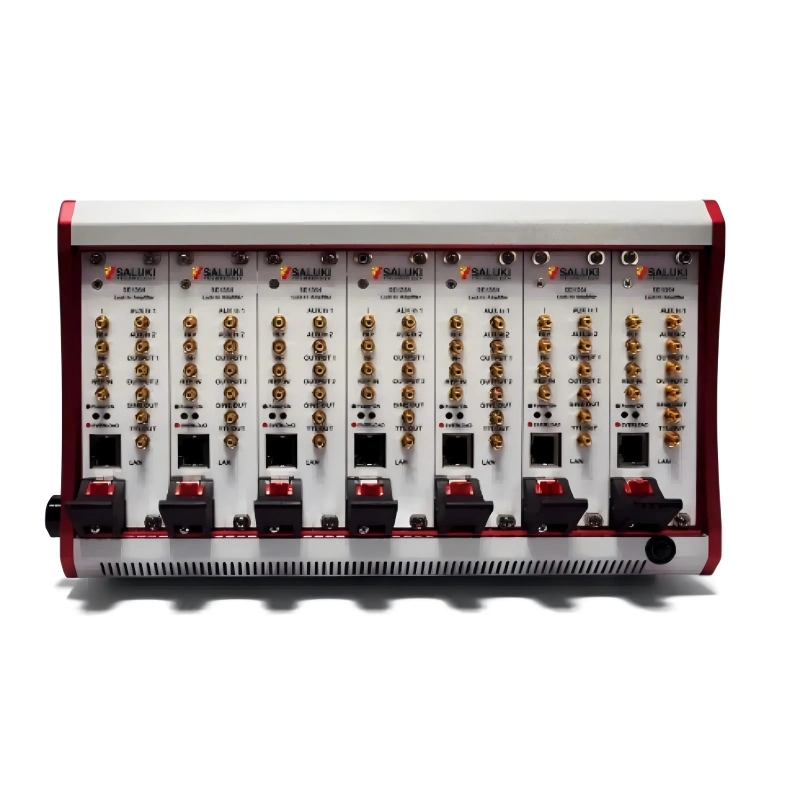
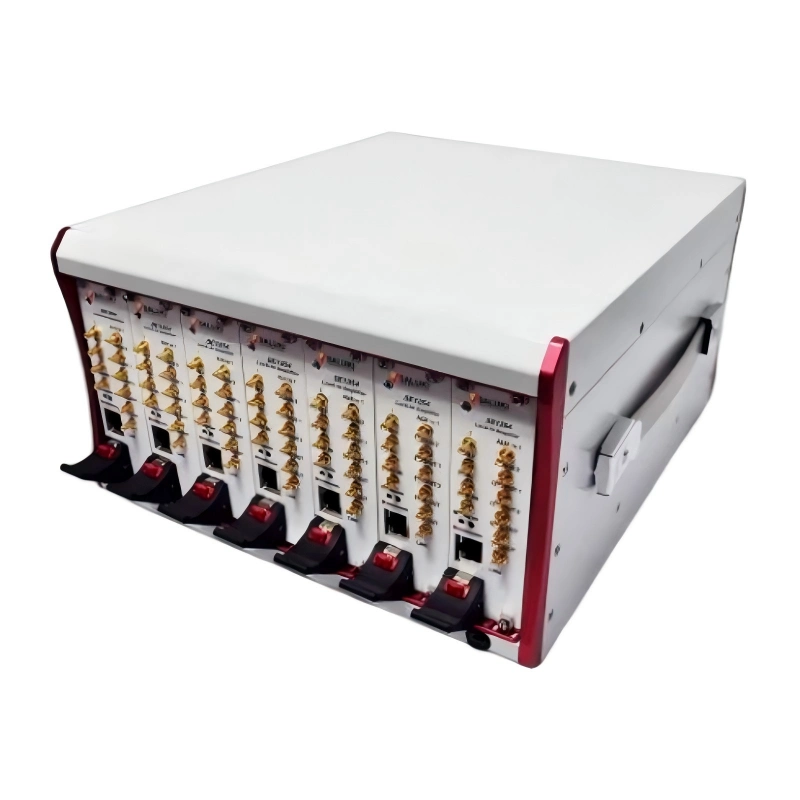
SE1354 Multichannel Lock-In Amplifier

The number of channels of SE1354 multi-channel lock-in amplifier can be flexibly customized (up to 10 channels are optional), and the bandwidth is 1uHz-100kHz/500kHz/1MHz optional; each channel is an independent and synchronous lock-in unit, and each channel contains: Voltage signal single-ended Input, voltage signal differential input, current signal input, TTL reference signal, sinusoidal reference signal input, TTL reference signal output, sinusoidal signal output, 2 auxiliary signal outputs and 2 auxiliary signal inputs.
The multi-channel lock-in amplifier SE1354 is a powerful tool specially developed for customers who need to measure multiple channels at the same time. Its excellent measurement accuracy and high integration make the customer’s system more integrated and measurement more convenient. Each channel can simultaneously realize the measurement of 1 fundamental wave and 7 harmonic demodulation channels. And 7 channels of harmonics can also be set to any frequency mode.

 3 channels Unit Price: US$21,609.00
 4 channels Unit Price: US$26,411.00
 5 channels Unit Price: US$31,212.00
 6 channels Unit Price: US$36,014.00
 7 channels Unit Price: US$40,816.00
 8 channels Unit Price: US$45,618.00
 9 channels Unit Price: US$50,420.00
 10 channels Unit Price: US$55,222.00

Key Features

Number of channels 3 to 10 channels optional

Frequency range 1μHz to 100kHz/500kHz/1MHz

1nV to 5V voltage measurement range

Time constants 1us to 3ks

Noise down to 5nV√Hz

8 arbitrary frequency demodulators per channel

Dynamic reserve up to 130dB

Communication interface: RS232, USB, network port

  • PC Software Operation

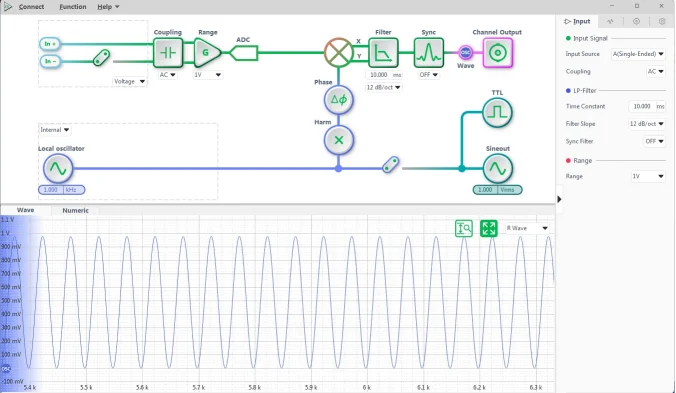
    It is accompanied by dedicated graphical host software. Featuring convenient graphical buttons and a comprehensive suite of graphical operation functions, the software also offers clear numerical and waveform display capabilities, allowing for the real-time visualization of measurement data. Measurement results can be exported and saved as CSV files for subsequent analysis using specialized software, ensuring a seamless and efficient testing experience. Furthermore, we provide full support for Python, MATLAB, and LabVIEW Application Programming Interfaces (APIs).

  • PID Control Interface

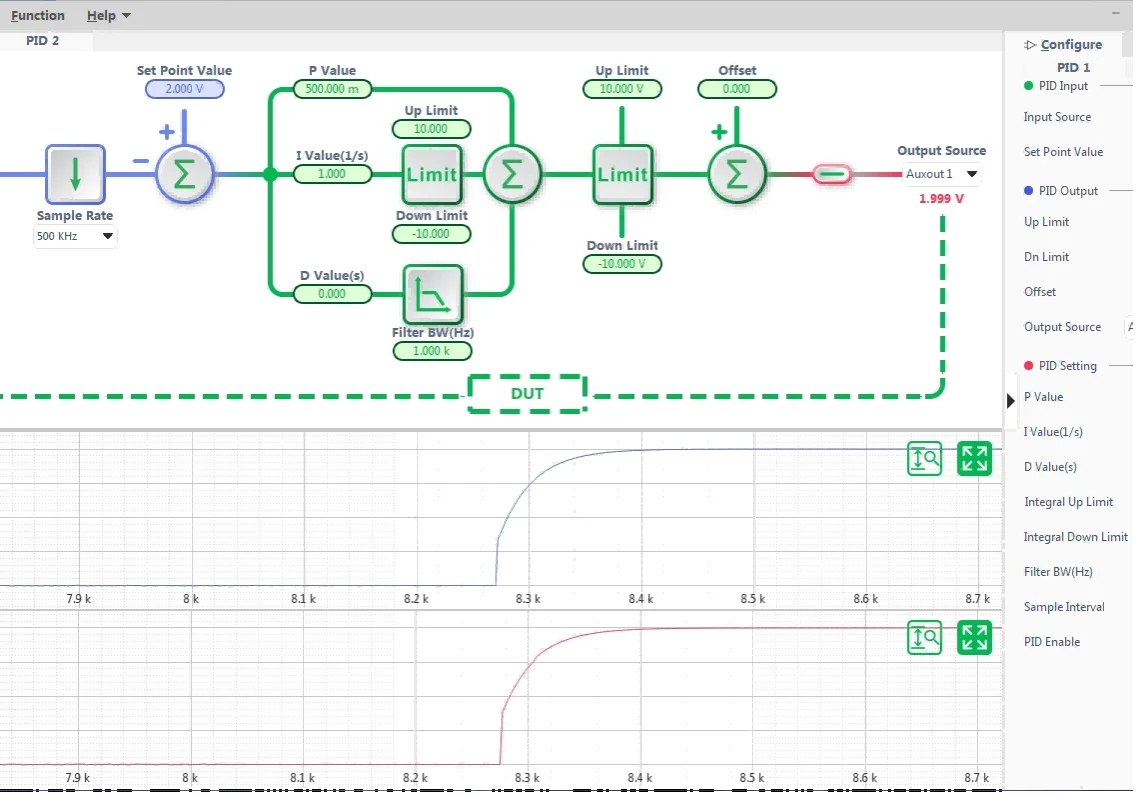
    The multi-channel lock-in amplifier features two independent, built-in digital PID controllers. Leveraging the high-speed processing capabilities of an FPGA, the PID sampling rate reaches up to 4 MSa/s. The PID algorithm is straightforward and intuitive; its control parameters are largely independent of one another, making parameter selection relatively simple. The PID controller delivers stable and precise control, adapting effectively to a wide variety of systems and efficiently handling dynamic system changes, thereby making it suitable for a broad range of applications.

  • Multi-demodulator

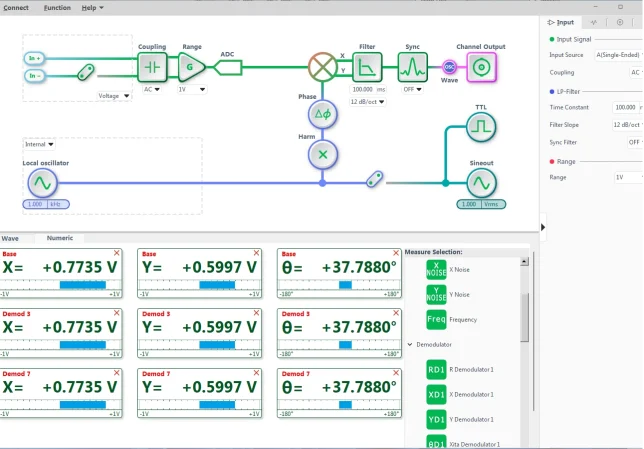
    In traditional lock-in amplifiers, only the fundamental frequency signal or a specific harmonic component can be measured at any given time. Consequently, for applications requiring the simultaneous measurement of the amplitude and phase of multiple frequency components, traditional lock-in amplifiers are unable to meet the necessary measurement requirements. The digital section of a multi-channel lock-in amplifier integrates FPGA and ARM technologies to achieve greater processing bandwidth and a more flexible digital architecture. It offers a digital processing precision of up to 48 bits and is capable of simultaneously analyzing up to eight input signals at arbitrary frequencies. Its eight demodulators can be freely configured for amplitude and phase, enabling linear combinations.

  • Oscilloscope

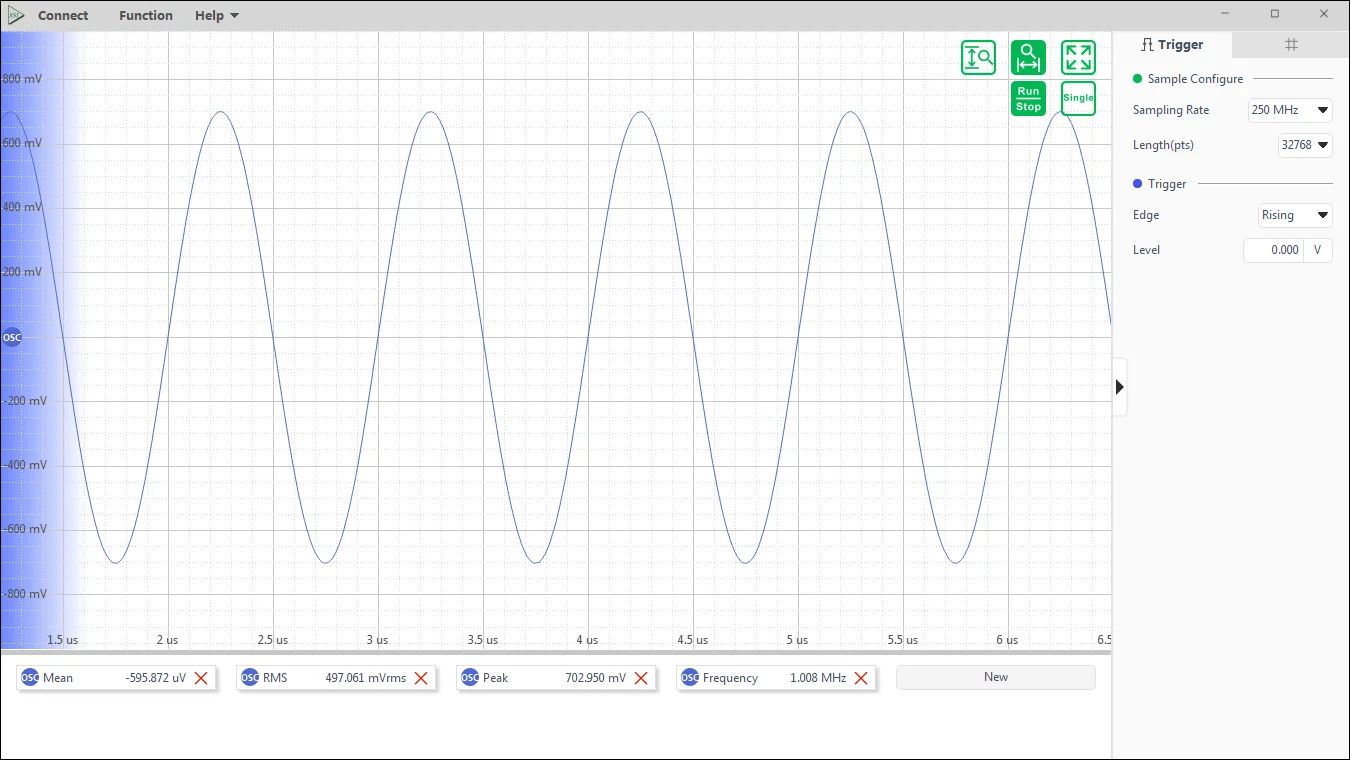
    The oscilloscope features a 4 MSa/s analog input channel with a 3 MHz analog bandwidth, a 5 Vrms input voltage range, and user-configurable AC/DC coupling and 10 MΩ impedance.

  • Spectrum Analyzer

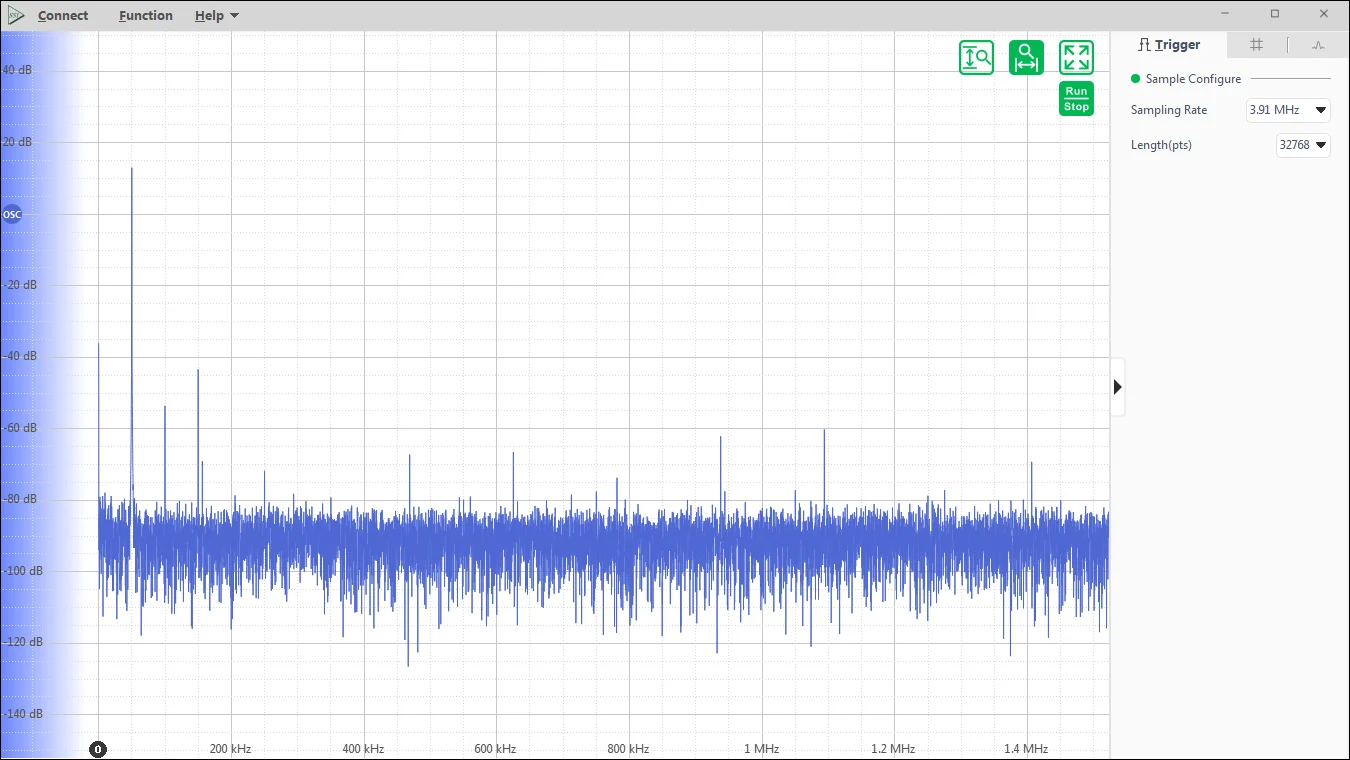
    The spectrum analyzer allows for the observation of input signals ranging from DC to 2 MHz in the frequency domain. Additionally, it features a resolution bandwidth as low as 1 Hz and a minimum span of 100 Hz.

1. Signal Channel
Voltage Input Mode

Single-ended or Differential

Full-scale Sensitivity

1 nV to 5 V in a 1-2-5 sequence

Current Input

106  V/A

Impedance

Voltage: 10 MΩ // 10 pF, AC or DC coupled

Current: 1 kΩ to virtual ground

C.M.R.R

> 70 dB to 10 kHz, decreasing by 6 dB/oct

Dynamic Reserve

> 120 dB

Gain Accuracy

0.2% typ, 1% max

Voltage Noise

5 nV/√Hz at 997 Hz

Current Noise

260 fA/√Hz at 997 Hz

2.Reference Channel
Input

Frequency range:  1 μHz to 1 MHz

Reference input: TTL or Sine

Input impedance: 10 MΩ

Phase

Resolution: 1 µdeg

Absolute phase error: < 1 deg

Relative phase error: < 0.01 deg

Orthogonality: 90° ± 0.001°

Phase noise: (Internal ref.) Synthesized, <0.0001° rms at 1 kHz;  (External ref.) 0.005° rms at 1 kHz (100 ms time constant, 12 dB/oct)

Drift: <0.01°/℃ below 10 kHz, <0.1°/℃ above 10 kHz

Harmonic Detection

2F, 3F, …nF to 1 MHz  (n<65,535)

Acquisition Time

Internal ref.: instantaneous acquisition

External ref.: (3 cycles + 5 ms) or 40 ms, whichever is larger

3. Demodulator
Stability

Digital output: no zero drift on all setting

Display: no zero drift on all setting

Analog output: <5 ppm/℃ for all dynamic reserve settings

Harmonic Rejection

-75 dB

Time Constant

1 µs to 3 ks (<200 Hz)

(6, 12, 18, 24, 30, 36, 42, 48 dB/oct rolloff)

Synchronous Filters

Below 1 kHz, a steep rolloff of greater than 18 dB/octave is effective.

4. Internal Oscillator
Frequency

Range: 1 µHz – 1 MHz

Accuracy: 2 ppm + 10 µHz

Resolution: 1 uHz

Distortion

-80 dBc (f < 10 kHz)

-70 dBc (f > 10 kHz)

Amplitude

100 µVrms to 5 Vrms

Accuracy

1%

Stability

100 ppm/℃

Sine Output

Sine signal output impedance is 50Ω

TTL Synchronous

5 V TTL/CMOS level

Output

output impedance 200Ω

5. Communication Interfaces

RS-232: standard 9-array RS-232 female socket

USB2.0

USB2.0 high-speed communication interface

6. Outputs
CH1 and CH2 Outputs

Function: output X, Y, R, θ

Amplitude: ±10 V

Drive Current: ±30 mA max

AUX Inputs

Function: 2 channel input

Amplitude: ±10 V

Impedance: 1 MΩ

7. General
Power Requirement

Voltage: 220 – 240 VAC

Frequency: 50 Hz / 60 Hz

Power: 50 W to 200 W

(Note: see more detail information in the ‘Resource’ – ‘Datasheet’)


Main Machine

SE1354 Multichannel Lock-In Amplifier 1μHz-100kHz/500kHz/1MHz optional, 3 to 10 channels optional, 1 nV to 5 V voltage measurement range

Leave A Message

    Saluki Technology